
You can clean your home and still notice that something in the air doesn't smell quite right.
Maybe it's the lingering smell of last night's cooking, pet odors that seem to settle into furniture, smoke from outside, or perhaps it's the faint smell of a new piece of furniture.
Air purifiers can help improve indoor air quality. But if you turn on your air purifier, let it run for hours, the smell doesn't completely disappear.
Why? Because not every type of air pollution is the same—different types of pollutants require different types of filtration.
A HEPA filter is highly effective at capturing airborne particles such as dust, pollen, and pet dander. But odors and certain gaseous pollutants requires a different type of filtration media: activated carbon.
That's why many air purifier combine HEPA filter with activated carbon filter.
So, what exactly is an activated carbon filter? How does it work? What can it help reduce? And what should you look for when choosing an air purifier with activated carbon filtration?
Let's take a closer look.
What Is an Activated Carbon Filter?
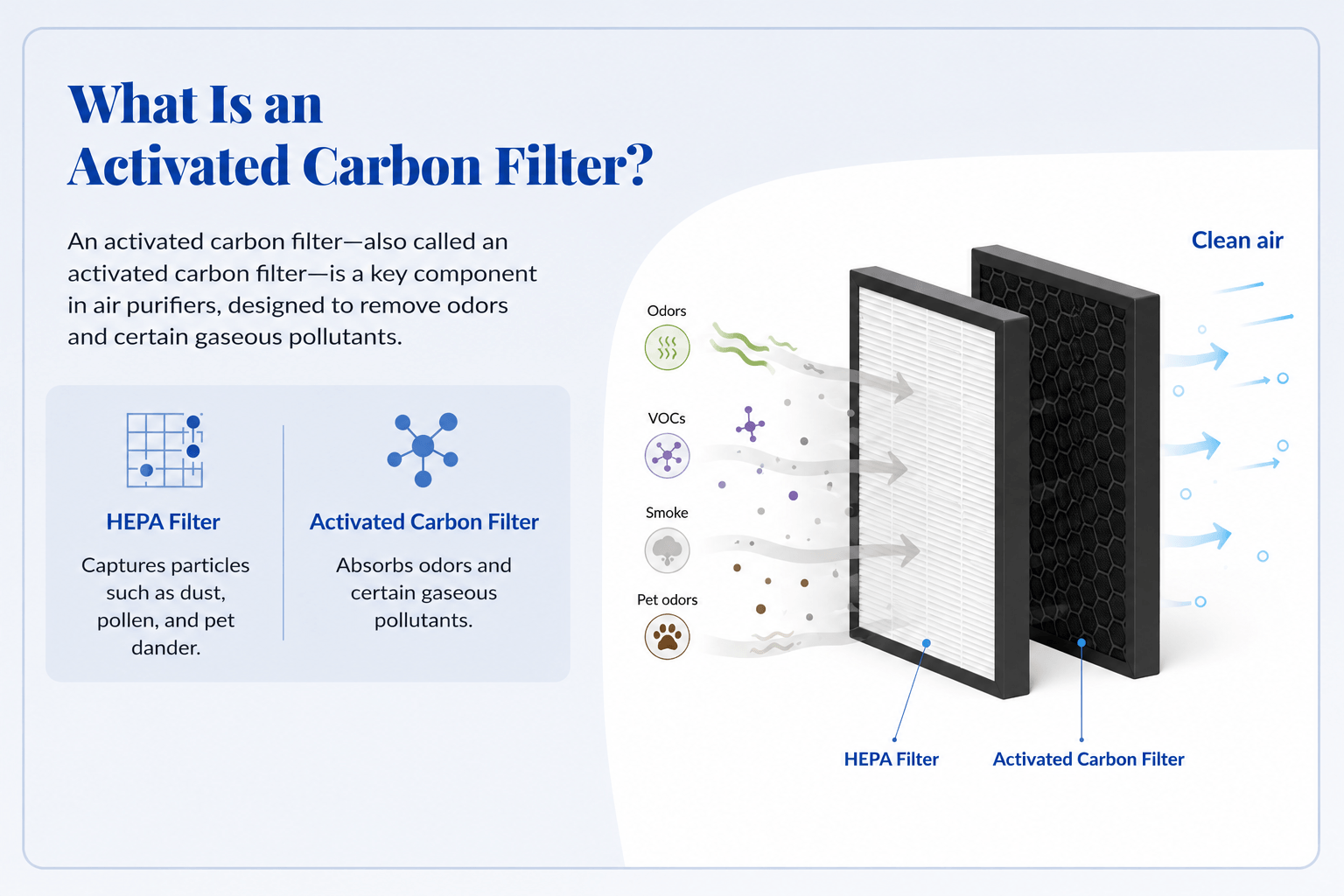
An activated carbon filter, also known as an activated charcoal filter, is a type of filter designed to reduce certain odors and gaseous pollutants.
Unlike a HEPA filter, activated carbon works primarily with odors and certain gaseous pollutants.
That’s why activated carbon and HEPA filtration are often used together in air purifiers.
How Does an Activated Carbon Filter Work?
The key to activated carbon filtration is its enormous surface area.
Activated carbon is processed to create a highly porous structure with a large surface area, allowing certain gas molecules to attach to the carbon as air passes through the filter.
What Does an Activated Carbon Filter Remove?
Activated carbon is commonly used to help reduce a range of household odors and certain gaseous pollutants, including:
Cooking Odors
Cooking activities such as frying, grilling, seafood preparation, and other strong-smelling foods can release odor-causing compounds into indoor air. Activated carbon can help reduce certain of these odors.
Pet Odors
Pets contribute not only hair and dander, but also odor-causing gases. Activated carbon can help reduce certain pet-related odors.
Smoke Odors
Smoke contains both particulate matter and gaseous compounds.
This is where HEPA and activated carbon perform different roles: a HEPA filter primarily captures particles, while activated carbon can help adsorb certain gaseous compounds and odors associated with smoke.
HEPA Filter vs. Activated Carbon Filter
HEPA filter and activated carbon filter are often used in the same purifier, but they perform different jobs.
|
|
HEPA Filter |
Activated Carbon Filter |
|
Main purpose |
Particle filtration |
Odor & gas filtration |
|
Targets |
Dust, pollen, pet dander, fine particles |
Odors, smoke, certain VOCs |
The two filtration technologies are not substitutes for one another. They are designed to handle different types of pollutants. That’s why many air purifiers combine a pre-filter, HEPA filter, and activated carbon filter as part of a multi-stage filtration system.
1. Pre-filter: captures larger particles such as dust and hair before the air reaches the finer filtration layers.
2. HEPA filter: focuses on fine airborne particles such as dust, pollen, and other small particles.
3. Activated carbon: helps address odors and certain gases.
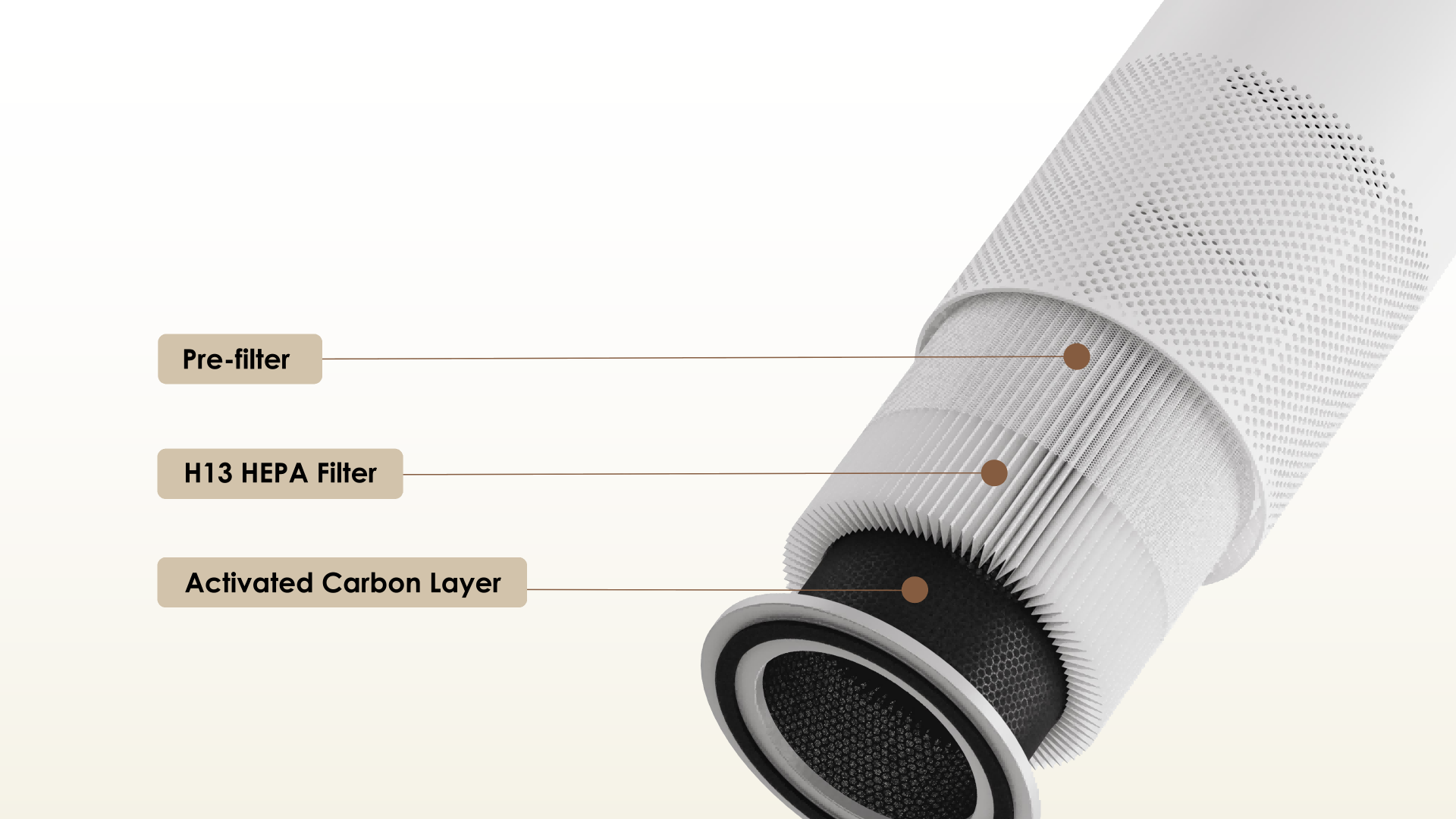
Together, these filtration stages provide a more comprehensive air purification system. This combination is also used across many Comefresh air purifier models.
Why Choose an Air Purifier with Activated Carbon Filtration?
If your main concern is airborne particles such as dust and pollen, particle filtration is essential. But if you also want to address cooking odors, pet odors, or smoke odors, activated carbon is an important feature to consider.
When comparing air purifiers, don't just look for an activated carbon filter. Also consider:
• Type and amount of activated carbon
• Overall filtration system
• CADR
• Recommended room size
• Operating noise
• Filter life and replacement cost
• Ease of maintenance
A Complete Air Purification Solution
Different spaces have different air purification needs. Bedrooms and home offices often prioritize quiet operation, while a living room or open space may require a higher CADR. For households with pets, exposure to smoke, or spaces with persistent odors, activated carbon filtration plays an important role.
Most Comefresh air purifiers incorporate activated carbon filtration, while selected models also feature UVC light or negative ion technology for different purification needs.
We also offer air purifiers across a range of CADR levels for different room sizes, from bedrooms to home offices and larger spaces. This allows users to choose a more suitable air purification solution based on their air needs.
Frequently Asked Questions
1. What does an activated carbon filter do in an air purifier?
An activated carbon filter uses adsorption to help reduce certain odors, gases, and VOCs. It is commonly combined with a particle filter such as a HEPA filter.
2. Does an activated carbon filter remove dust?
Activated carbon is primarily designed for gas-phase filtration rather than particle filtration. Dust, pollen, and other airborne particles are typically handled by a particle filter such as a HEPA filter.
3. Does activated carbon remove odors?
Activated carbon can help reduce many common household odors through adsorption. Its performance depends on factors such as carbon type and loading, airflow, pollutant concentration, and the specific odor-causing compounds.
4. Does activated carbon remove VOCs?
Activated carbon is commonly used in gas-phase filt ration and can help reduce certain VOCs. Performance varies depending on the specific VOC and filter design.
5. How long does an activated carbon filter last?
There is no universal replacement interval. Follow the manufacturer's recommendations and consider usage, indoor conditions, and the design of the filter.
Post time: Aug-26-2026